Friday, June 15, 2012

Flag Day: A History

Vintage post card with patriotic theme (web archive)
It is Philadelphia in the year 1777. The 2nd Continental Congress is meeting every day including this, the Saturday of June 14.

The business of the day includes everything from the suspension of a Massachusetts sea captain "of doubtful character," to the provisioning of New York state with 2,000 bushels of salt as they have been severely shorted from the war and the closing of her harbors.

Other business includes new duties for Major General Benedict Arnold and Captain John Paul Jones. Arnold is given command of "all the [new] militia now at Bristol" and along the Hudson River to the east of Philadelphia. Captain Jones is made commander of the warship Ranger.

The flag, Betsy Ross, George Washington and Benjamin Franklin  (web archive)


Within the day's debate, discussion, and decisions is a simple, 31-word sentence that codifies the symbol of this new nation. It is the description of her flag:

Resolved, that the flag of the thirteen United States be thirteen stripes, alternate red and white: that the union be thirteen stars, white in a blue field, representing a new constellation.


Lincoln's 2nd inaugural address (photo: AmericanRhetoric.com)
"With malice toward none; with charity 
for all..."
Although the national flag is created during the Revolution, it is not until the Civil War had torn this nation apart that the idea of celebrating the flag as a symbol of unity is born. Needless to say, the idea is not immediately popular in the American South.


The first Flag Day parade was ... where?
Many places lay claim to the first Flag Day parade. Its history is a story of pride, of celebration – and of patience!

• In 1861, George Morris of Hartford, CT organizes a Flag Day parade in June. This is the first year of the Civil War. Fort Sumter, its first battle, is as recent as April 12.


(photo: National Flag Day Foundation)
• In 1885, Bernard Cigrand organizes a Flag Day in Wisconsin. In 1894, Cigrand organizes another in Chicago. Reports indicate that over 300.000 children participated in parades throughout the city's parks. Cigrand claimed he gave over 2,000 speeches on creating a national holiday to celebrate the flag. He is the founder of the American Flag Day Association and later became a president of the National Flag Day Society. Needless to say, Cigrand is regarded by many as the father of Flag Day. 

Before Flag Day became a national holiday, however, there were several notable flag celebrations.

 • In 1887, 100 years after that first June 14, Congress orders the flag to be flown from all public buildings throughout the nation (www.History.com). 

Seminal versions of the flag from our history.
• In 1907, the Elks make it an annual tradition to fly the flag on June 14.

• In 1909, Fairfield, WA has its first Flag Day parade. This and Morris' Hartford, CT parade are the oldest Flag Day parades recorded and though both are long running, neither has been continuous. 

• In 1916, President Woodrow Wilson makes Flag Day an official "day" which is not at all the same thing as being a national holiday. The date coincides with American involvement in World War I. In 1914, however, the President had declared the first Mother's Day as a time to fly the flag.

Flag Day, June, c. 1914 (Library of Congress)
• In 1949, President Harry Truman makes Flag Day an official national holiday. Although Cigrand has passed away, William Kerr, a colleague of Cigrand's and the founder of the National Flag Day Society (the National Flag Day Foundation) is in attendance at the president's invitation.

• In 1950, Appleton, WI hosts its first Flag Day parade, a parade which has been running continuously!

• In 1952, Quincy, MA began its parade which also has been held every year ever since!

But the biggest parade (according to online sources), a parade claiming to draw as many as 50,000 people in a city with a population of about that same number, is the Troy, NY Flag Day parade

These pictures are from 2012 Flag Day parades and one very special one from Troy, NY's 2011 Flag Day parade.

Flag Day parade, Troy, NY (TimesUnion©, 2012)
Flag Day parade, NYC (prleap©, 2012)
Flag Day parade, Palymyra, MO (PalmyraSpectator©, 2012)
Let it fly!
Uncle Sam in Troy, NY, his birthplace (Mikecny's©, 2011)


Thursday, June 14, 2012

Decorating for July 4: Here come the cockades!

Stars and Stripes repeat flag bunting as a cockade
Bunting! Flags! Banners! It's hard not to get excited when decorating for July 4. Here are some ideas that all come from our repeat flag pattern bunting or ribbon. It comes in different widths (4"x6" and 12" x 18"). 

Stars and Stripe cockades – what a Revolutionary idea!
And they are. Cockades were popular 18th century and 19th century decorations on hats, jackets, cushions – you name it. It was and is an easy, inexpensive and a highly decorative way to take ribbon and make something that grabs the eye.

A decorative, half cockade...
The half-cockade fan decoration starts with a length of flag bunting (4 flags long) from the flag pattern ribbon bunting. Start by folding the first flag so that half the stars are folded underneath for a clean edge. 

Holding the material at the bottom edge in your left hand, simply start folding the ribbon bunting like a fan: Hold the fabric at the bottom so that the top fans out and the bottom stays tight.

We made two folds on each little flag pattern: one fold was at the edge of each star field and the other was about mid-way through the stripes. At this point, just work it with your hands. It is flexible (it's cotton) and easy to manipulate.


When you have your folds where you want them, crease them with your hands or iron them down. Then, either make a stitch or add a drop of hot glue inside each fold at the bottom, so that it all stays together. You do not need to glue down or stitch this together anywhere else. Also make sure you fold the last flag edge under, like you did with the first flag.

Hot glue your button over the bottom part of the fan. If you want to make it into a pin, just glue gun on a pin backing. They're easy to find at any craft store. You're done!

Materials: 
1 roll flag pattern ribbon bunting
glue gun (or needle and thread)
stick pins
optional pin backing (available at any craft store)

See it with pictures:

Starting to fold. Left edge already tucked under.


Figuring out the next fold. This determines the others.

Nearly done and not yet glued so nothing is written in stone.

Gluing everything else, then sorting out that last fold over.

Done! All glued and ready to use as decoration or wear.

A full ribbon cockade ...  

Ribbon cockade by Idle Hands
This ribbon cockade is very effective and not too difficult if you are handy with a needle – as in knowing how to thread one. 

These instructions come from the blog, Instructables: Make a Ribbon Cockade.

You will need 4' (or more) of 1" grosgrain ribbon to duplicate this cockade or similar. The longer the ribbon, the more points or folds you can have in your cockade.

Materials:
4' or more of 1" ribbon 
needle and thread 
stick pins


Flags with swag!
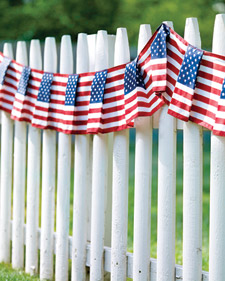
You can use our flag pattern ribbon bunting as a fence swag in several ways.Two versions are below. 

Flag Swag 1

Attach the flag bunting to the rail, evenly spaced and tied each tied down with string. Make sure the "hang" of the swag also is even. 
Pre-measure all the ribbon lengths before cutting so that they, too, will be even in size.  You can tie a bow at each swag without any tails hanging, or you can tie a bow with an extra long and decorative tail. Third version: No bow! Just make a neat circle around each swag with the knot tied on the bottom and the ends tucked inside.

Bow tying tip:
Before you cut anything, play with the ribbon. Tie it different ways. Use the flag pattern to help you determine the size and effect you want. We based our ribbon on a simple bow with each half being the size of one flag.
 
Flag Swag 1 (via usflagstore.com)


Flag Swag 2
If you sew the bunting before you attach it to the railing, the folds can wave in the breeze. It takes a bit more time and about double the bunting but it's a clean and effective look.

Instructions come from MarthaStewart.com.

Flag swag 2 (via MarthaStewart.com)

If you have any bunting ideas, please email us (lpb.usflagstore@gmail.com) with pictures so we can share them on Facebook.

Let it fly!

Friday, May 25, 2012

Flying the Flag on Memorial Day


Memorial Day is one of the few holidays the federal government sets aside as an official time for everyone to fly the flag. 

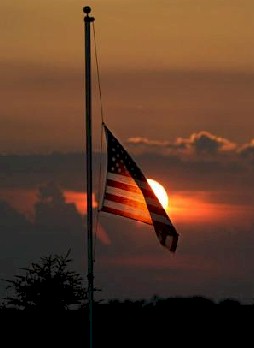
But flying the flag on Memorial Day is different than flying it on Independence day. This is a memorial holiday so the flag needs to be flown at half-staff but only for part of the day.

How do you correctly raise a flag to half-staff? 

What part of Memorial Day does it fly at half-staff?  And then what do you do?

Here's the scoop according to the US Flag Code
 
How long does the flag fly at half-staff on Memorial Day? ...
And then what do you do?
The US Flag Code: Position and Manner of Display (section m) says the flag should be flown at half-staff on Memorial Day until noon. After noon, it is then raised to the top until it is taken down:

"The flag, when flown at half-staff, should be first hoisted to the peak for an instant and then lowered to the half-staff position. The flag should be again raised to the peak before it is lowered for the day. On Memorial Day the flag should be displayed at half-staff until noon only, then raised to the top of the staff" (US Flag Code).

How to fly the flag at half-staff
When the flag flies at half-staff, it needs to be raised and lowered in the same way: Make sure to run the flag up all the way to the top of the pole before lowering it to the half-staff position. When you lower the flag for the day, you need to do the same thing: make sure you run it up to the top before you completely lower it.

Needless to say, the flag never touches the ground. It is considered a sign of disrespect as the flag is not just a national symbol, but the symbol we carry into battle, the symbol for which many have given their life.

Memorial flags at the US Capitol.
The full list of holidays the flag flies at half-staff:
• Memorial Day
• Pearl Harbor Remembrance Day
on the day of and the day after the death of a United States senator, representative, territorial delegate, or the resident commissioner from the Commonwealth of Puerto Rico
on the death of a state's governor (from the day of death until interment)
• on the death of a governor of a territory or possession (from the day of death until interment)
• on days the President has indicated at his/ her discretion to mark the death of other officials, foreign dignitaries, or after other tragic events.

USFlagstore follows the flag guidelines from the US Flag Code

For complete instructions for displaying and caring the flag, see our blog page, Flag Etiquette 101.
 
Let it fly!


Monday, May 21, 2012

Make a Flag Bouquet!

Flag bouquet with 3 sizes of flags.
Want to make a flag bouquet? 

It's easy. We promise.

There are two basic types of flag bouquets: the bud vase technique (flag in vase) and a blossoming bouquet of flags. We're calling this The Martha and naming it after First Lady Martha Washington.


Style #1: The Bud Vase Technique
The bud vase technique takes as few as one or as many as 3-4 of our smallest stick flags and simply displays them in a small vase or even a pencil holder.
Flag in a champagne flute


That's it. Simple and cheerful. The bud vase technique is great for a side table or desk.

If you take a champagne flute and add some confetti, shreds of mylar, or even curled ribbon along with a single stick flag, it's a great addition to individual place settings. 


Style #2:
The Martha Washington Flag Bouquet
There are two secrets to a full flag bouquet and here they are:

1) Use a planter, not a vase because flags are full, big things and vases don't really work that well. We tried. We tried a lot. Let us save you the time. Get a planter.

2) Use a planter that is oval or rectangular. Round looks too confined unless it is large, over 14" in diameter. The flags want to spread out and wave so they really need the room. The planter we used is 16" wide and 6" high.

Choosing a filler
 We suggest filling the planter with styrofoam, or using a large, solid styrofoam center piece that you surround with dry rice or beans. The rice or beans are good for sticking the small flags into. The large, centerpiece of styrofoam is necessary for holding up the larger flags so nothing tips.

The traditional crossed flag design
Arranging the flags
Start with an outside ring of small stick flags. The 4"x6-8" stick flags work the best for this. We used 16 of these small stick flags but figure a minimum of 12 would be necessary to really make it look full. 

All you need to do is place the smallest flags into the styrofoam base but take a little care! Once styrofoam has holes in it, it can weaken. If you use a thick bed of dry rice or beans, you will be able to stick the flags in and not worry about this. If you use styrofoam, just be careful.


For the 2nd layer of flags, we used 4 8"x12" stick flags. We used them in pairs with each pair in the traditional crossed flag pattern, similar to the letter "X". This worked well in our oval planter as well as in a rectangular one.

For a finishing touch, we wanted a topper so we used 1 large 12"x18" stick flag in the center. Now you are done!


As an option ...
As an option, you can simply stand 3-4 8"x12" flags upright and still use a single, large 12"x18" stick flag in the center.

We'd love to see how your flag bouquet turns out. Join USFlagstore on FB and post them on our wall. In the meantime ...

Let it fly!


Saturday, May 5, 2012

Armed Forces Day: Freedom Is Never Free

Courage to Stand, is a tribute to U.S. Armed Forces. 
(Produced by Canadian Trooper Matthew Worth)

We chose this video as part of our observance of Armed Forces Day as it expresses not only respect for all branches of the US military, but a point of view we believe is common to all sides of our political spectrum, namely, that our success as a nation is largely due to the freedoms we enjoy as citizens of this nation. The quote below is not an endorsement of any political party or politician. It is just the narration of this video – and a really good quote.

"Humans can not reach their potential, cannot realize their dreams unless they are free. If prosperity were easy, everyone around the world would be prosperous. If freedom were easy, everybody around the world would be free. If security were easy, everybody around the world would be secure. They are not! None of this is going to be easy, but this is the United States of America. It takes an extraordinary effort, it takes extraordinary commitment, it takes extraordinary strength. Valley Forge wasn’t easy. Going to the moon wasn’t easy. Settling the West wasn’t easy. We are the American people. We have seen difficulties before and we  always overcome them. This is about rolling up our sleeves [despite our] differences as Americans and putting our head down, and getting it done."   
~ former Wisconsin Governor Tim Pawlenty

Official Armed Forces Day poster, 2012
In the beginning, there was the Army
The U.S. Army been around since ... well, since the very beginning and it was created out of the idea of a voluntary force. 

The US Army, however, didn't celebrate an official anniversary until 1924 on National Defense Test Day, not a popular holiday. 

In 1928, the anniversary was moved to May 1, May Day, otherwise known as World Communism Day. 

That didn't make much sense either.

Then in 1936, President Franklin Delano Roosevelt chose April 6, the anniversary of our entry into World War I, as a good date to represent the anniversary of the U.S. Army. This time, the date stuck.

Official US Navy flag
Then the Navy...
From 1922-1950, Navy Day was celebrated on October 27 for two main reasons: In 1775, the Continental Congress decided to re-outfit merchant ships as warships, hence the idea of a naval corps was born. The other reason is that October 27 is the birthday of a former Assistant Secretary of the Navy, Theodore Roosevelt.

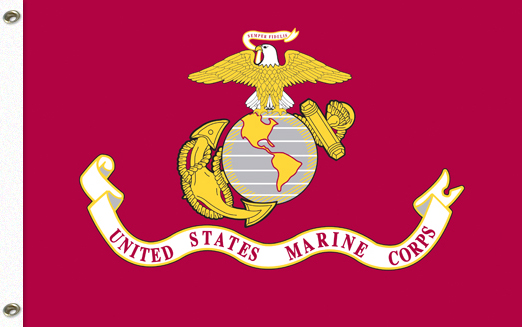
Flag of the US Marine Corps
... and the Marine Corps 
Ah, the Marines. They date to the Revolution, too. And like much about our Revolution, they find their way back to Philadelphia. 

Created on November 19, 1775, the Marines received a fare-thee-well after the Revolution. Apparently, the new government thought funding the Marines too costly. But in 1798, they were back and under the jurisdiction of the Navy. Marine Corps Day traditionally was celebrated on the Marine Corps' birthday, November 10.

The flag of the US Coast Guard
The Coast Guard is born
As Secretary of the Treasury, Alexander Hamilton created the first Coast Guard in 1790 for the express purpose of collecting US tariffs.  

Coast Guard Day traditionally was celebrated on August 4.


The official Air Force flag
With the Air Force, a new age
Air Force Day was a completely different holiday. Plus, the Air Force was newer than any other military branch.

On August 1 in 1907, the Army created an aeronautical division.

On August 1 in 1947, President Truman recognized this branch of the military with an official Air Force Day, a part of the US Army. Now the Air Force is its own division of the military, the US Air Force.

US Army official flag
One Department of Defense
In 1947, the Department of Defense was created to act as a governing body for all the branches of the U.S. military. 

One holiday for all military branches
In 1950, under President Harry Truman, all the military holidays were officially consolidated into Armed Forces Day so that one day could be a day to celebrate all of our military. Within the separate branches, some of the original holidays are still celebrated.
President Truman makes Armed Forces Day official.

Let it fly!

partial  list of sources: 
American Presidency Project (presidency.ucsb.edu)
Department of Defense (defense.gov)
NYTimes archives
Timeanddate.com
Truman Library (Trumanlibrary.org)