Friday, December 30, 2011

The Christmas Eve Truce: 12.24.1914

The lines of the infamous Western Front of WWI

Five months after the start of World War I, a spontaneous truce crept into the enemy trenches along the Western Front. It was a brief cease fire that lasted about 24 hours and was filled with the singing of Christmas carols. This was Christmas Eve, 1914. 
The Western Front stretched across parts of Belgium, France and Germany and included soldiers from those countries as well as England. In the first year of the war, over 1 million soldiers would die along the Western Front.

To see a truce break out amidst this death land, a truce that was not created by any government but one that was created by the soldiers in those trenches, is a truly extraordinary thing.

Photo: Lt. Cyril Drummond (Imperial War Museums, London)
The photo (right) was taken on Christmas Day, 1914 in the "no man's land" between the two lines of enemy trenches. It includes English soldiers (from the Royal Dublin Fusiliers) and German soldiers near St. Yvon in the Ypres Salient.


In the trenches (LLT.org)
The Christmas Eve truce is not the only time such a cease-fire has been called, but it is the most famous. A part of what sometimes is referred to as the "live and let live" system, such informal truces can emerge from the heat of war (http://www.iwm.org.uk). 

One book that discusses such circumstances during World War I is Trench Warfare, 1914-1918: The Live and Let Live System (Ashworth). 

Another good resource about the Christmas Truce is Long, Long Trail (LLT.org) which presents a detailed chronology of the truce and the events that lead up to it (starting from Dec. 5, 1918) as well as after (through December 31). This resource also can tell you which British regiments were there and the names of the soldiers.

Here is a video documenting the Christmas Eve Truce (video by PBS.org):


Monday, December 19, 2011

Texas: The Lone Star State


The "Come and Take It" flag of the Texas revolution, 1835
It's October 3, 1835, in the town of Gonzalez, Tejas and a white flag is flying. 

This white flag, however, is not a truce flag. Quite the opposite.

This white flag proudly carries a single star above a cannon as it boldly proclaims, "Come and Take It." 

Santa Anna
The taunt at once refers to the canon on the flag, originally a gift from the Mexican government, as it also refers to the spirit of independence that marks this first battle for Texas independence from the rule of the Mexican dictator, President Antonio López de Santa Anna.


Come the following spring, by March 2, 1836, and Texas will have won her independence and declared herself an independent republic. 

An independent nation 
For nearly 10 years Texas was an independent republic. 

On December  29, 1845, Texas becomes the 28th state to join the United States of America. Then, in 1861, Texas seceded from the Union to join the Confederacy.

The Coajuila y Tejas, Mexican state flag
Back in 1835, however, Texas was part of the Mexican state of Coahuila y Tejas, "tejas" meaning "allies" or "friends". The Mexican state flag for the Coahuila y Tejas state had two stars on it. When Texas fought for its independence from Mexico, it kept a star from the Mexican design and became known as the Lone Star Republic and then, when it joined the United States, it became the Lone Star State.

Other flags flew on behalf of Texas independence, a movement that spread throughout the United States and inspired independent battalions of volunteers to join the fight for Texas independence.  

The Dodson flag, c. 1835
A tri-color flag with the Texas lone star was sewn by Sarah Dodson in December, 1835. It was sewn for the battle at San Antonio de Bexar.


The current Texas state flag with its single star


Joanna Troutman (or Johanna Troutman) from Georgia created a lone star flag, also in 1835. The Troutman flag flew at the Battle of Goliad. Her flag has a blue star and bears the legend, "Liberty or Death." 
Cronin portrait of Joanna Troutman with flag


The Troutman flag is sewn out of white silk with blue silk stars on both sides.


Lorenzp de Zaval Texas flag
The Lorenzo de Zaval flag has a blue field with a white star encircled by the letters T-E-X-A-S. 

The de Zaval flag was adopted as the flag of the new republic in May, 1836.


The Burnet flag of the Texas republic
By December 10, 1836, the flag was again changed, this time to include a gold star on a blue background. It was designed by David G. Burnet. The Burnet flag is the first flag to bear the distinction of being the first official flag of the Republic of Texas.


The current Texas state flag was designed by Dr. Charles Stewart and adopted January 5, 1839. Dr. Stewart was the second person to sign the Texas Declaration of Independence. Before the Burnet flag became the official flag for the state of Texas, it flew as the third official flag of the Republic of Texas.

Did you know Texas has the right to divide into four states?
The Constitution of 1845, a federal document that relates to Texas' incorporation as a state, gives Texas the right to divide into as many as four states. The document, however, allows Texas to divide just one time, and one time only.

Other flags that flew for Texas Independence and some interesting online resources ... 
These flags have interesting stories behind them that are well clicking on the attached links below or at http://bit.ly/vjWsQf. 

PBS has produced an excellent 8-part documentary on the Wild West. The episode on Texas is titled, Tejas and can be found at http://to.pbs.org/vfBhud

Davy Crocket, US Senator and hero from the Alamo
Lastly, the Portal to Texas History  is an excellent academic resource linking historical collections throughout the state of Texas, including university archives and it is viewable online.

To find out about the Alamo, including the debunking of several myths associated with that famous battle (there were survivors), go the TheAlamo.org.

Let It Fly!

Sherman's Kentucky volunteers fought at the Battle of San Jacinto
The 1st Co. of Texas Volunteers fought at Goliad, Bexar and the Alamo
The Texas Red Rovers flag flew at Goliad, March 27, 1836


Thursday, December 15, 2011

The Flags of December


The first three – the very first three – of the original 13 colonies have their statehood birthdays in December.


Happy statehood to Delaware (12.7.1787), the first state; to Pennsylvania (12.12.1787), the second state; and to New Jersey (12.18.1787), the third state of the new nation!

The Delaware state flag


The Pennsylvania state flag


New Jersey's state flag


An Ordinance for the Government of the Territory of the United States North-West of the Ohio River: From Territories into States
The Northwest Ordinance of 1787 made it possible for territories to evolve into statehood, if so desired. It was determined early on that between 3-5 states could be created out of this territory. It also stated that settled regions with less than 5,000 voters (free, white males) were considered districts. Their government was by presidential appointment: a governor, a secretary and three judges.

When there were 5,000 voters in a district, it became a territory and voters were able to elect their own legislature and one congressional representative. The congressional representative could speak in Congress but had no official vote. The governor remained a presidential appointment.


When territories grew to a population of 60,000, it could apply for statehood. Prior to statehood, a state constitution would have to be drafted along with a state bill of rights that guaranteed religious freedom, trial by jury, and the right of habeas corpus. A strong effort was made to prohibit slavery in the new territory (this was not entirely successful).

Four years in a row in the month of December, new states emerge out of the western territories.  
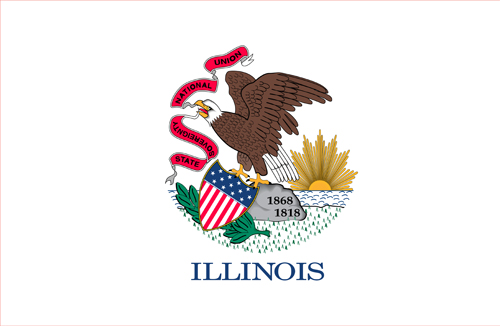
Indiana (12.11.1816), Mississippi (12.10.1817), Illinois (12.3.1818) and Alabama (12.14.1819) are the 19th, 20th, 21st and 22nd states.  Here is a look a their state flags and an explanation of each state's name...

The state flag of Indiana with its 19 stars.
 Indiana is the Hoosier state, a word whose true meaning is a mystery although it is the subject of much conjecture. The name Indiana, however, simply means Indian land.


The Mississippi state flag
The name Mississippi means "big river" from Ojibwa words meaning big (mshi) and river (ziibi).


The state flag of Illinois, the illinek or "the people"


Illinois comes from an Algonquin word meaning "the people" (illinwek).


Alabama's state flag
 Alabama comes from a Choctaw word meaning "harvesters".


Texas and Iowa: The 28th and 29th States
The 28th and 29th states, Texas and Iowa, have their statehood dates on December 29 and December 28, 1845 and 1846, respectively.


While Texas was birthed out of two revolutions: the American Revolution and the Mexican Revolution, Iowa's state boundaries were effected by the fight to end slavery – or to allow it to continue in the new territories.


The state flag of Texas                           


The state flag of Iowa


Let it fly!

Tuesday, December 6, 2011

Pearl Harbor & Sands Islands: Two Hero Tales

That fighting spirit ...
Lt. John Finn, c. 1941
Of all the Medal of Honor recipients from the attack on Pearl Harbor, John William Finn held a unique distinction. Until May of 2010, he was the oldest surviving Medal of Honor recipient. 

Finn also was quite a character. Born in California in 1909, Finn dropped out of high school at 17 in order to join the US Navy. When Pearl Harbor was attacked, Finn had been in the service for 15 years. 


At the time of the bombing, Finn and his wife were sound asleep. But when he heard the buzz of planes, he woke up. At first, he saw something fly by his window and then he heard the machine guns. At that point, Finn didn't wait to hear or see anything more but drove to a hangar, grabbed a machine gun, set up on a hill, and started shooting.


For two and a half hours, Finn shot at the invading planes with a .30 caliber machine gun. By the end of the attack, he had been hit "28 or 29" times. His body was torn from bullets and schrapnel. He was shot in the hand and shot in the foot. 

Finn, however, was not done fighting. He got bandaged up and then went back to see if there would be a second attack. He didn't get to a hospital until the afternoon of December 8. [Author's note: Mrs. Finn may well have been a motivating force for that particular visit.]


To read the citation for John Finn's Medal of Honor, click here.

Here is a US Navy video detailing the attack on Pearl Harbor. It includes actual film of the attack:


At Sand Island on Dec. 7, 1941 ...

First Lt. George Cannon, c. 1941
Out on Sand Island in the Midway Islands, a chain of tiny points of land and volcano tips in the Pacific that stretch into to the Hawaiian Islands, the United States Marine's had deployed Battery H of the Sixth Defense Battalion. As of September, 1941, Battery H on Sand Island, Midways had a new commander, First Lt. George Cannon.


George Cannon's sense of duty is clear from the barest outlines of his history. Born in Webster Groves, Missouri, Cannon joined the ROTC at the University of Michigan. In 1938, he made the rank of First Lieutenant in the US Army before resigning that post in order to join the Marines at the rank of Second Lieutenant in 1939.


By the time Cannon arrived on the Midway Islands in September, 1941, he had been promoted to the rank of First Lieutenant in the United States Marine Corps for barely a month. When Sand was bombed as an ancillary act to the main attack on Pearl Harbor, Cannon was wounded but refused to leave his post. What he did do, however, was to make sure his men were evacuated. For these actions, First Lieutenant George Cannon was awarded the Medal of Honor, posthumously. In 1943, the USS Cannon (1943-1944) was named in his honor.


To learn more about Lt. George Cannon, go to this link at the Naval Historical Center.

A great resource from the US Navy with oral histories, photographs and even film from the Pearl Harbor attack can be found here.  

The US Navy's website at http://1.usa.gov/11GHCt is a great resource for additional information, including the names and the citation details for the medal recipients from Pearl Harbor. 

Remember to fly the flag at half-staff for Pearl Harbor Remembrance Day, December 7. If you are not sure how or when to fly a flag at half-staff? Click here to find out. USFlagstore.com's facts come from the US Flag Code.

Let it fly!
If you have a hero's story to share, we encourage you to share the history.


To find find out how to fly the flag and other flag etiquette, see USFlagstore's  Flag Etiquette 101 and USFlagstore's How to Fly the Flag at Half-Staff.

Heroes of Pearl Harbor


NOTE: Be sure to fly the flag at half-staff on Pearl Harbor Remembrance Day!
If you are not sure how or when to fly a flag at half-staff, click here to find out. Our facts come from the US Flag Code.  
 

Remembering Pearl Harbor
December 7, 1941 

Life Magazine, the Pearl Harbor issue 12.22.1941
This December 7 marks the 70th anniversary of the attack on Pearl Harbor and the United States' official involvement in World War II. In that single day, for that single event, there were heroes from every rank – from commanders and majors, to ensigns, machinists, firemen, gunners, and reservists. There also were the unnamed heroes whose names families can recall better than history books. 

Here, we wish to remember all the heroes of Pearl Harbor so you will find the names of the 15 recipients of the Medal of Honor, the 51 recipients of the Navy Cross, the 3 recipients of the Navy and Marine Corps Medal, and the 4 recipients of the Silver Star.

If you have a hero's story to share from Pearl Harbor, we hope you will post it.

The Medal of Honor
The Medal of Honor is the highest military decoration given by Congress. It is given in recognition for extreme valor. From the attack on Pearl Harbor, 15 were chosen to receive this medal. You can read about these heroes and read their individual citations at the Naval History & Heritage website.
 
Recipients of the Medal of Honor from Pearl Harbor:
Mervyn Sharp Bennion

John William Finn   

Francis Charles Flaherty

Samuel Glenn Fuqua

Edwin Joseph Hill

Herbert Charpoit Jones

Isaac Campbell Kidd

Jackson Charles Pharris

Thomas James Reeves

Donald Kirby Ross

Robert Raymond Scott

Peter Tomich

Franklin Van Valkenburgh

James Richard Ward

Cassin Young


Recipient of the Medal of Honor from Sand Island, Midways, December 7, 1941:

George H. Cannon

The USS West Virginia with her flag flying (National Archives)
To learn more about this 16th Medal of Honor awarded on December 7, 1941 as well as the oldest Medal of Honor recipient from Pearl Harbor, check our blog on George Cannon and John William Finn.


The Navy Cross
At the end of World War I, the Navy Cross was the third highest decoration given by the Navy for acts of bravery in combat. In World War II, Congress elevated the Navy Cross to the second highest medal that can be awarded for bravery in combat. It ranks immediately beneath the Medal of Honor. It is the highest decoration the Navy awards and, though typically awarded to members of the Navy, the Coast Guard or the Marines, the Navy can award it to anyone serving in any branch of the US military (www.history.navy.mil).

Photo: www. history.navy.mil
Recipients of the Navy Cross from Pearl Harbor

Austin, John A., Chief Carpenter, USN, casualty of USS Oklahoma

Baker, Lionel H., Pharmacist’s Mate second class, USN

Bolser, Gordon E. Lt.(jg), USN

Bothne, Adoloph M., Boatswain, USN

Burford, William P., Lt. Comdr., USN

Christopher, Harald J., Ens., USNR, casualty of USS Nevada

Curtis, Ned B., Pharmacist’s Mate second class, USN

Daly, Edward Carlyle, Coxwain, USN, casualty of USS Downes

Darling, Willard D., Cpl., USMC

Davis, Frederick C., Ens., USNR, casualty of USS Nevada

Dickinson, Clarence E. Jr., Lt., USN

Douglas, C. E., Gunnery Sgt., USMC

Driskel, Joseph R., Corporal, USMC

Dunlap, Ernest H. Jr., Ens., USN

Edwards, John Perry, Ens., USNR

Etchell, George D., Shipfitter, USN

Fleming, W.D., Boatswain’s Mate first class, USN

Gombasy, L.G., Seaman second class, USN

Graham, Donald A., Aviation Machinist’s Mate first class, USN

Hailey, Thomas E., Sgt., USMC

Hansen, Alfred L., Chief Machinist’s Mate, USN

Huttenberg, Allen J., Ens., USNR

Isquith, Solomon S., Lt. Cmdr. USN

Jewel, Jesse D., Comdr.(MC), USN

Kauffman, Draper L., Lt., USNR

Larson, Nils R., Ens., USN

Ley, F. C. Jr., Fireman second class, USNR

McMurtry, Paul J., Boatswain’s Mate first class, USN

Mead, Harry R., Radioman second class, USN

Miller, Doris (Dorie), Mess Attendant first class, USN (ship's cook)

Miller, Jim D., Lt., USN

Moore, Fred K., Seaman first class, USN, casualty of USS Arizona

Outerbridge, William W., Lt. Comdr., USN

Parker, William W., Seaman first class, USN

Peterson, Robert J., Radioman second class, USN

Pharris, Jackson C., Gunner, USN (upgraded to Medal of Honor)

Phillips, John S., Comdr. USN

Riggs, Cecil D., Lt. Comdr. (MC), USN

Robb, James W. Jr., Lt.(jg), USN

Roberts, William R., Radioman second class, USN

Ruth, Wesley H., Ens., USN

Singleton, Arnold, Ens., USN

Smith, Harold F., Boatswain’s Mate second class, USN

Snyder, J. L., Yeoman first class USN

Taussig, Joseph K. Jr., Ens., USN

Taylor, Thomas H., Ens., USN

Teaff, Perry L, Ens., USN

Thatcher, Albert C., Aviation Machinists Mate second class, USN

Thomas, Francis J., Lt. Comdr., USN

Thomas, Robert E. Jr., Ens., USN

Vaseen, John B., Fireman second class, USNR


The Navy and Marine Corps Medal
The Navy and Marine Corps Medal is the second highest decoration awarded by the US Navy, immediately below the Navy Cross. It is awarded to members of the US Navy or Marine Corps who risk their lives in combat. The medal was created during World War II. Recipients include President Kennedy.

Recipients of the Navy and Marine Corps Medal from Pearl Harbor
Francis D. Day

Aloysius H. Schmitt

Paul R. Wright


The Silver Star
The Silver Star is the third highest military decoration. It is awarded by the US Army for distinguished courage in action against an enemy and may be awarded to anyone serving in the armed forces. 

Recipients of the Silver Star from Pearl Harbor
Edwin H. Kiefer

Theodore W. Marshall

George T. Owen

Alan Shapley


Let it fly!  

To find find out how to fly the flag and other flag etiquette, see USFlagstore's  Flag Etiquette 101 and USFlagstore's How to Fly the Flag at Half-Staff.